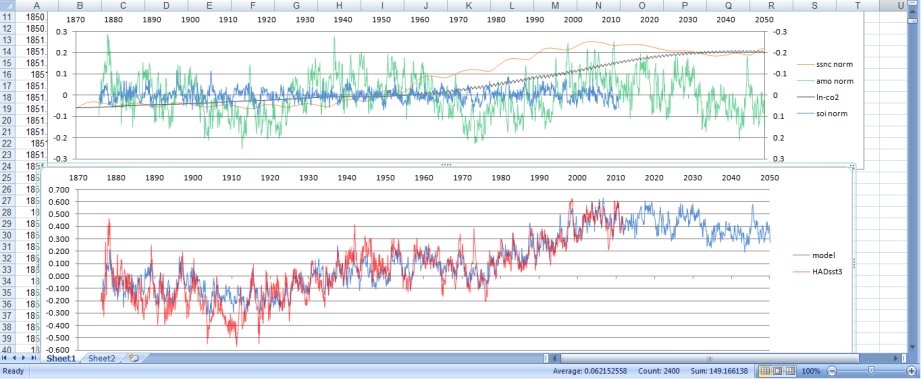



Image from PDF on NASA/NIST TSI Workshop July 18-20, 2005,
R. C. Willson click image or link
The brief presentation linked above shows some of the story, more follows…
Our favourite weatherman has something to tell us:
An expected return to more changeable weather through this week reminded me of the work of one of our best known and most respected climatologists Professor Hubert Lamb.
Professor Lamb is credited with discovering an empirical relationship between low solar activity and an increased probability of higher pressure in winter across more northern latitudes – which leads to colder winters across the UK and Europe.
Another part of his work was to analyse weather patterns over 100 years to try and see if any repeat themselves across the UK, with some success.
Murray Salby’s Hamberg Lecture has been posted on youtube by Sebastian Lüning. H/T Pierre Gosselin.
Of great importance is Salby’s finding that in large part, CO2 is controlled by global temperature, rather than the other way round as the warmists claim. Regulars might recall the discussions we’ve had on this issue before. here and here. The final ten minutes of the presentation are devastating to the warmist perversion of climate science. At the very end of the lecture Salby tells us he met Feynman at Caltech many years ago. He quotes the Feynman Chaser to round off the lecture.
(more…)
Do you have any idea how incredibly stupid that sounds to a statistician? Statistical significance can only be determined by using statistical tests. That’s why the term “statistically” is in front of “significant.” That was the whole point of Parliament’s question.
Over at Suyts
Keenan Confirmed!!! Met Position Laid To Utter Waste!!
Posted on June 9, 2013 by suytsEditor [suyts] Note: This post is written by Hank. Anyone familiar with Hank’s style and demeanor knows he’s not given to bombastic statements. However, if one reads this post, one can plainly and easily see how entirely inept our climate science community is.
Here we go again. Expensive statutes and rules based on unavailable data.
President Obama’s nominee to head up the Environmental Protection Agency (EPA), Gina McCarthy, is awaiting a confirmation vote. Senate Republicans may still filibuster. The agency’s reliance on “secret science,” long a concern for the role it has played in EPA’s decisions, is finally emerging.
She almost didn’t make it out of the Environment and Public Works committee. Wisconsin Republican Sen. John Barrasso spoke on behalf of the Senate GOP regarding why they were boycotting her nomination, saying “What we’re simply requesting is access to the scientific data and reasoning behind the justification for expensive new rules…”
Popcorn futures explode. But joking apart, I think (hope) this will be productive. Tim Palmer is realistic about model uncertainty (apart from being clueless about the magnitude of uncertainty around solar caused climate variation). Brian Hoskins is candid (though behind the curve on the latest findings).
GWPF INVITES ROYAL SOCIETY FELLOWS FOR CLIMATE CHANGE DISCUSSION
London, 22 May: In response to a suggestion by Sir Paul Nurse, the President of the Royal Society, the Global Warming Policy Foundation has invited five climate scientists and Fellows of the Royal Society to discuss the current state of climate science and its wider implications.
In a letter to Lord Lawson, the GWPF chairman, Sir Paul stated that the Royal Society “would be happy to put the GWPF in touch with people who can offer the Foundation informed scientific advice.”
Sir Paul suggested that the GWPF should contact five of their Fellows: Sir Brian Hoskins; Prof John Mitchell; Prof Tim Palmer; Prof John Shepherd and Prof Eric Wolff.
The GWPF has now invited the five climate scientists to a meeting with a team of members of the GWPF’s Academic Advisory Council and independent scientists and has proposed a two-part agenda:
Ben Pile has posted a long and well written piece about l’affaire Lewandowsky at his blog. It will soon be published on Spiked, but I thought a preview to be in order. The paragraphs below are from the concluding section, since most here are familiar with the story so far. If not, you should read the whole thing.
Extract from: The Lewandowsky Papers
Posted by Ben Pile on May 21, 2013
Scientists such as Lewandowsky are better at self-justification than scientific research. Rather than being an investigation into the workings of the material world, Lewandosky’s ‘research’ — a poorly executed and error-prone online survey, seen through dodgy statistical methods and bogus categories — is a naked attempt to explain why people dare challenge scientific authority. But there are good reasons for challenging it. Science has turned its gaze on the public as politicians have sought to remedy their diminishing public support by recruiting the academy. It is not a coincidence that the scientific agenda increasingly reflects the prejudices and problems of elite politics.
(more…)
More and more, we are seeing citizens being invited to “participate” in various forms of meetings, councils, or boards to “help determine” public policy in one field or another. They are supposedly being included to get ”input” from the public to help officials make final decisions on taxes, education, community growth or whatever the particular subject matter might be.
Sounds great, doesn’t it? Unfortunately, surface appearances are often deceiving.
You, Mr. or Mrs. Citizen, decide to take part in one of these meetings.
Generally, you will find that there is already someone designated to lead or “facilitate” the meeting. Supposedly, the job of the facilitator is to be a neutral, non-directing helper to see that the meeting flows smoothly.
Actually, he or she is there for exactly the opposite reason: to see that the conclusions reached during the meeting are in accord with a plan already decided upon by those who called the meeting.
Many of us love looking at the work done by real do-ers, the things they make for the fun and pain of doing it. These are the same as scientists of old.
Someone known as Robert has put up a web site showing his experimental physics done old style, create the devices yourself. He does glass work too.
“and also for the defibrillation of elephants.” but we won’t go there just now.
I’ve chosen the following item since it starts to approach the bizarre world of wave/particle duality. He has done much more.
Magnesium Photoelectric Cell
When electromagnetic radiation falls on a metal surface, electrons can be released. Electron emission only occurs if the frequency of the radiation is above a value called the threshold frequency. The threshold frequency is dependent upon the type of material.
Wave theory does not explain the photoelectric effect. Instead, it is necessary to consider the radiation as particles called photons. The energy of each photon is related to the frequency by E = hf where E is the energy in joules (J), h is Planck’s constant (6.626×10⁻³⁴Js) and f is the frequency in Hz. Joules can be converted to electron volts by dividing by 1.6×10⁻¹⁹.
From Nature.com blogs, indications that Keven Trenberth is returning to the scientific method. Hopefully, he’ll get real about the toa energy balance uncertainty too.
Predictions of climate
Kevin Trenberth
I have often seen references to predictions of future climate by the Intergovernmental Panel on Climate Change (IPCC), presumably through the IPCC assessments (the various chapters in the recently completedWorking Group I Fourth Assessment report ican be accessed through this listing). In fact, since the last report it is also often stated that the science is settled or done and now is the time for action.
In fact there are no predictions by IPCC at all. And there never have been. The IPCC instead proffers “what if” projections of future climate that correspond to certain emissions scenarios. There are a number of assumptions that go into these emissions scenarios. They are intended to cover a range of possible self consistent “story lines” that then provide decision makers with information about which paths might be more desirable. But they do not consider many things like the recovery of the ozone layer, for instance, or observed trends in forcing agents. There is no estimate, even probabilistically, as to the likelihood of any emissions scenario and no best guess.
Even if there were, the projections are based on model results that provide differences of the future climate relative to that today. None of the models used by IPCC are initialized to the observed state and none of the climate states in the models correspond even remotely to the current observed climate.